
 Doppler Effect (Light)
This calculates the change in wavelength due to the Doppler effect of light.
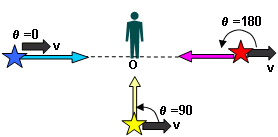
Set the angle θ at which the light source is moving to 180 degrees when it is receding, 0 degrees when it is approaching, and 90 degrees when it is moving sideways.
| Observed light source wavelength λ | nm |
| Light source frequency ν | GHz |
| Ratio of the light source’s velocity to the speed of light: v0/c | % |
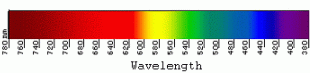
When a yellow (570 nm) light source moves away at a speed of 10% of the speed of light, it appears red (630 nm); when it approaches, it appears blue (515 nm).
| \(\normalsize Doppler\ effect\ for\ light\\ (1)\ \lambda=\lambda_0{\frac{\large 1-\frac{v}{c}\cos\theta}{\large\sqrt{1-\frac{v^2}{c^2}}}\hspace{40px}\nu=\nu_0{\frac{\large\sqrt{1-\frac{v^2}{c^2}}}{\large 1-\frac{v}{c}\cos\theta}}}\\ (2)\ \lambda\nu=\lambda_0\nu_0=c=299792.458km/s\) |
No customer feedback for this calculation yet.