
 Numerical Integration Using the Trapezoidal Rule and Simpson’s Rule
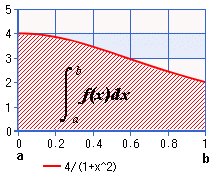
Calculate the integral over the finite interval (a, b) using the trapezoidal rule, the midpoint rule, and Simpson’s rule.
The number of subdivisions is doubled at each step: 2, 4, 8, 16, ..., N. The integrand f(x) is assumed to be analytic and nonperiodic.
| \(\normalsize \hspace{40px}S={\large\int_a^{b}}f(x)dx\\ (1)\ Trapezoid\hspace{5px}S_{\normalsize t}={\large\frac{b-a}{2}}\{f(a)+f(b)\}\\ (2)\ Midpoint\hspace{10px}S_m=(b-a)f({\large\frac{a+b}{2}})\\ (3)\ Simpson\hspace{10px}S_{\normalsize s}={\large\frac{S_{\normalsize t}+2S_m}{3}}\\ \hspace{105px}={\large\frac{b-a}{6}}\Biggl[f(a)+4f({\large\frac{a+b}{2}})+f(b)\Biggr]\\ \) |
No customer feedback for this calculation yet.