
 Parabolic Motion (Calculated from Initial Velocity and Time)
Calculate the launch angle, maximum altitude, and maximum distance when an object is launched at a given initial velocity without air resistance and falls after a given time in flight.
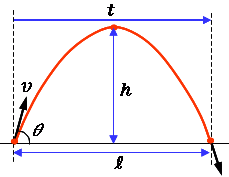
| Launch angle θ | ° |
| Maximum Altitude h | m |
| Distance Traveled l | m |
| \(\normalsize Parabolic\ motion\\ (1)\ l=\sqrt{v^2-({\large\frac{gt}{2}})^2}t\\ (2)\ h={\large\frac{1}{2}}g{\large(\frac{t}{2})}^2={\large\frac{gt^2}{8}}\\ (3)\ \theta=\tan^{\tiny -1}{\large\frac{4h}{l}}\\\) |
No customer feedback for this calculation yet.