
 Parabolic Motion with a Height Difference (Calculated from Initial Velocity and Angle)
This calculates the flight time, maximum altitude, and distance traveled when an object is launched from a point with a height difference at a given initial velocity and angle, assuming no air resistance.
If the landing point is higher than the launch point, set the elevation of the launch point to a negative value.
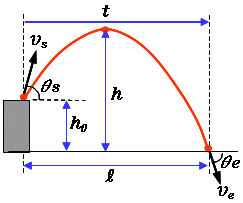
| Flight Time t | seconds |
| Maximum Altitude h | m |
| Distance Traveled l | m |
| Landing velocity Ve | m/s |
| = | km/h |
| Landing angle θe | ° |
| \(\normalsize Parabolic\ motion\ from\ elevation\\ (1)\ h=h_0+{\large\frac{\left(v_s\sin\theta_s \right)^2}{2g}}\\ (2)\ v_e=\sqrt{\left(v_s\cos\theta_s\right)^2 + 2gh}\\ (3)\ \theta_e=\tan^{\tiny -1}\left({\large\frac{\sqrt{2gh}}{v_s\hspace{1px}\cos\theta_s}}\right)\\ (4)\ l={\large\frac{{v_s}^2\sin2\theta_s +{v_e}^2\sin2\theta_e}{2g}}\\\) |
No customer feedback for this calculation yet.