
 Calculating Pi (Inscribed and Circumscribed Polygons)
Calculates pi (π) from the perimeters of regular polygons inscribed in and circumscribed around a circle of diameter 1.
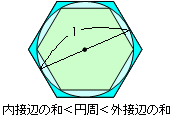
The calculation ends when the values of the inscribed and circumscribed sides become equal. Increasing the number of digits used in calculations improves the precision of π.
From ancient times up until around the 17th century, approximations of pi were derived from polygons inscribed in and circumscribed around a circle.
Starting from the initial 4-sided polygon and 6-sided polygon, the algorithm calculates polygons with successively doubled numbers of sides (×2^n).
Recursive Algorithm
a: Perimeter of the circumscribed polygon, b: Perimeter of the inscribed polygon
| \(\normalsize (1)\ a_0=\left\{{\large{4\atop 2\sqrt{3}}}\right.\ ,\hspace{20px}b_0=\left\{{\large{2\sqrt{2}\hspace{20px}:square\atop\hspace{20px} 3\hspace{30px}:hexagon}}\right.\\ (2)\ a_{n+1}={\large\frac{2a_n b_n}{a_n+b_n}}\ ,\hspace{20px}b_{n+1}=\sqrt{a_{n+1}b_n}\\ (3)\ b_n\lt\ \pi\ \lt a_n\\ \) |
No customer feedback for this calculation yet.