
 Gauss-Kronrod Numerical Integration
Compute the integral over the finite interval (a, b) using the Gauss-Kronrod method.
The integral value is calculated using the following procedure.
(1) The integral value is calculated using the Gauss-Legendre integration method with the number of subintervals (n-1)/2.
(2) The integral value is calculated using the Gauss-Kronrod integration method with a number of partitions of n.
(3) The 2 integral values obtained above are compared to determine the integral value with guaranteed accuracy.
| \(\normalsize {\large\int_{\small -1}^{\small 1}}f(x)dx\simeq{\large\displaystyle \sum_{\small i=1}^{n}}w_{i}f(x_i)\\ \) |
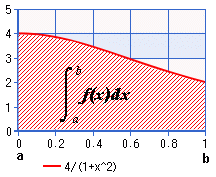
The integrand f(x) is assumed to be analytic and not a periodic function.
| \(\normalsize Gauss-Kronrod\ integration\\ (1)\ {\large\int_a^{b}}f(x)dx={\large\frac{b-a}{2}\int_{\small -1}^{\small 1}}f({\large\frac{b-a}{2}}y+{\large\frac{b+a}{2}})dy\\ (2)\ {\large\int_{\small -1}^{\small 1}}f(x)dx\simeq{\large\displaystyle \sum_{\small i=1}^{n}}w_{i}f(x_i)\\ \) |
No customer feedback for this calculation yet.