
 Numerical integration in the semi-infinite domain (a,∞)
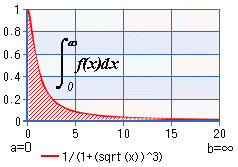
Compute the integral over the semi-infinite domain (a,∞) using the double exponential (DE) numerical integration method. This is suitable when the function decays algebraically at infinity.
The integrand f(x) is assumed to be analytic except at the endpoints and not to be a periodic function.
| \( \normalsize Double\ exponential\ integration\\ (1)\ x\rightarrow e^{{\normalsize\frac{\pi}{2}}\sinh(t)}\\ \ {\large\int_{\tiny a}^{\tiny\infty}}f(x)dx={\large\int_{\tiny 0}^{\tiny\infty}}f(x+a)dx={\large\int_{\tiny -\infty}^{\tiny\infty}}f(x(t)+a)x'(t)dt\\ \hspace{140px}x(t)=e^{{\normalsize\frac{\pi}{2}}\sinh(t)}\\ \hspace{140px}x'(t)=e^{{\normalsize\frac{\pi}{2}}\sinh(t)}\frac{\pi}{2}\cosh(t)\\ (2)\ Trapezoid\\ \hspace{20px}S\simeq{\large\int_{-t_a}^{t_a}}f(x(t))x'(t)dt=h{\large\displaystyle \sum_{{\small j=-}\frac{N}{2}}^{\frac{N}{2}}}f(x(jh))x'(jh)\\ \hspace{240px}h={\large\frac{2t_a}{N}}\\ \) |
No customer feedback for this calculation yet.