
 Trapezoidal Rule
Calculate the integral over the finite interval (a, b) using the trapezoidal rule.
The number of subdivisions is doubled at each step: 2, 4, 8, 16, ..., N. The integrand f(x) is assumed to be analytic and nonperiodic.
| \(\normalsize\ Trapezoid:\\ \hspace{20px}S={\large\int_a^{b}}f(x)dx=\hspace{5px}{\large\frac{h}{2}}\{f(a)+2{\large \displaystyle \sum_{j=1}^{n-1}}f(a+jh)+f(b)\}\\ \hspace{60px}h={\large\frac{b-a}{n}}\\ \) |
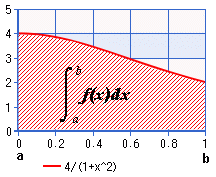
| \(\normalsize \hspace{10px}S={\large\int_a^{b}}f(x)dx\\ (1)\ Trapezoid\\ \hspace{5px}S_{\normalsize t}={\large\frac{h}{2}}\{f(a)+2{\large \displaystyle \sum_{j=1}^{n-1}}f(a+jh)+f(b)\},\hspace{10px} h={\large\frac{b-a}{n}}\\ \) |
No customer feedback for this calculation yet.