
Required Tightening Torque for Bolts
Author: zero03Executions: 10453
※ This library was created by a member. This site is not responsible for its content.
Assumptions:
・F: The load required to tighten the gasket, divided by the number of bolts
・u: Coefficient of friction at the threaded contact surface (typically 0.15–0.2); this value increases if the threads are rough
・D: The effective diameter (D = (bolt hole diameter + diameter of the inscribed circle of the nut) / 2) of the nut seating surface in contact with the flange seating surface
・n: Coefficient of friction between the nut seating surface and the flange seating surface (typically 0.15–0.2); this value increases if either surface is rough
・1/2 of the thread opening angle = cos 30°/2 = 0.866
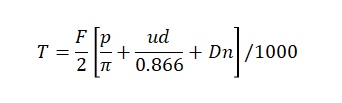
| Tightening torque: T | N·m |
Source of the calculation formula: ASME PCC-1
No customer feedback for this calculation yet.
*However, since this is an estimate, the strength of
flanges, bolts, gaskets, etc., when tightened to the calculated value is not verified.
Because there is a risk of deformation or damage, this calculation is provided for reference only.