
Calculating the parameter K for the negative binomial distribution (NBD) model
Author: tonagaiExecutions: 5339
※ This library was created by a member. This site is not responsible for its content.
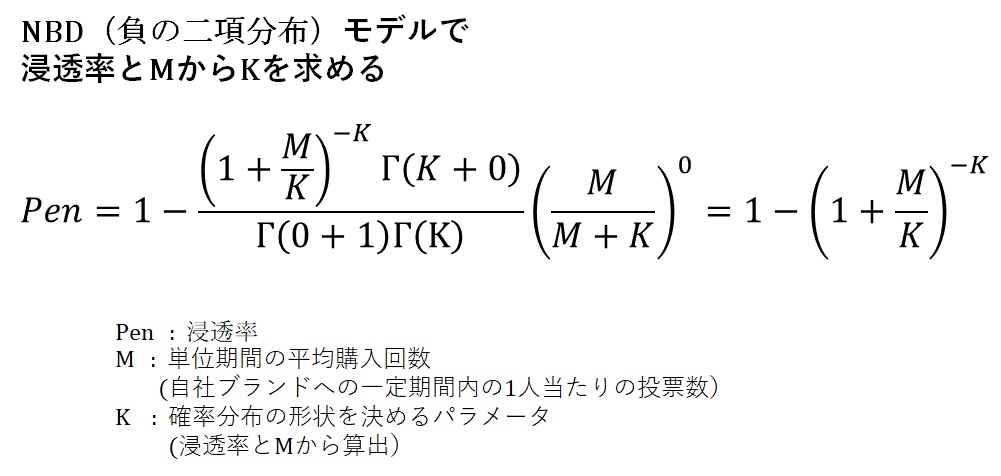
Pen: Penetration rate (in %)
M: Average number of purchases per unit period (number of votes per person for the company’s brand within a given period)
M: Average number of purchases per unit period (number of votes per person for the company’s brand within a given period)
| K |
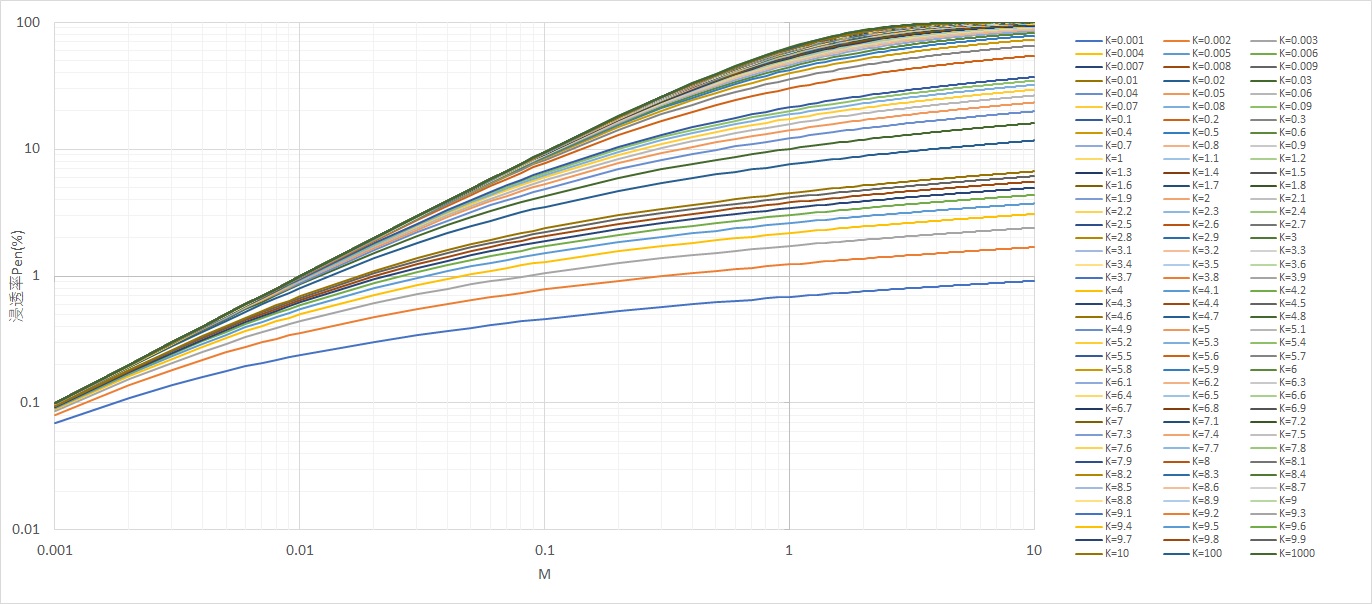
There isn’t a solution for all values of Pen and M. See the graph above.
- Related links
 Negative Binomial Distribution Model (NBD Model) for the Probability of Purchase Frequency
- I’ve uploaded a calculation using the NBD model (negative binomial distribution) to determine the probability of purchase frequency to Casio’s high-precision calculation site, keisan.casio.jp! (After watching Professor Hayashi’s interview with Takeshi Morioka, I became interested in “mathematical marketing,” so I bought and read *Strategic Thinking Based on Probabilistic Thinking*.)
- I uploaded the calculation for parameter K—which determines the probability distribution of the NBD model (negative binomial distribution) used to estimate the probability of purchase frequency—to Casio’s high-precision calculation site, keisan.casio.jp! (After watching Professor Hayashi’s interview with Takeshi Morioka, I became interested in “mathematical marketing,” so I bought and read *Strategic Thinking Based on Probabilistic Thinking*.)
- Delishley NBD Model: Probability of Purchasing the Company’s Own Brand Within a Category
- Delischlé NBD Model: Own-Brand Purchase Rate: Probability of Purchase
- I uploaded the calculation for parameter K—which determines the probability distribution of the NBD model (negative binomial distribution) used to estimate the probability of purchase frequency—to Casio’s high-precision calculation site, keisan.casio.jp! (After watching Professor Hayashi’s interview with Takeshi Morioka, I became interested in “mathematical marketing,” so I bought and read *Strategic Thinking Based on Probabilistic Thinking*.)
No customer feedback for this calculation yet.
Reference: “Strategic Thinking Based on Probability: The Power of Mathematical Marketing, Proven at USJ” (Tsuyoshi Morioka, Seiki Imanishi)