
Suspension Stroke Simulation (Beta Version)
Author: WUNExecutions: 14541
※ This library was created by a member. This site is not responsible for its content.
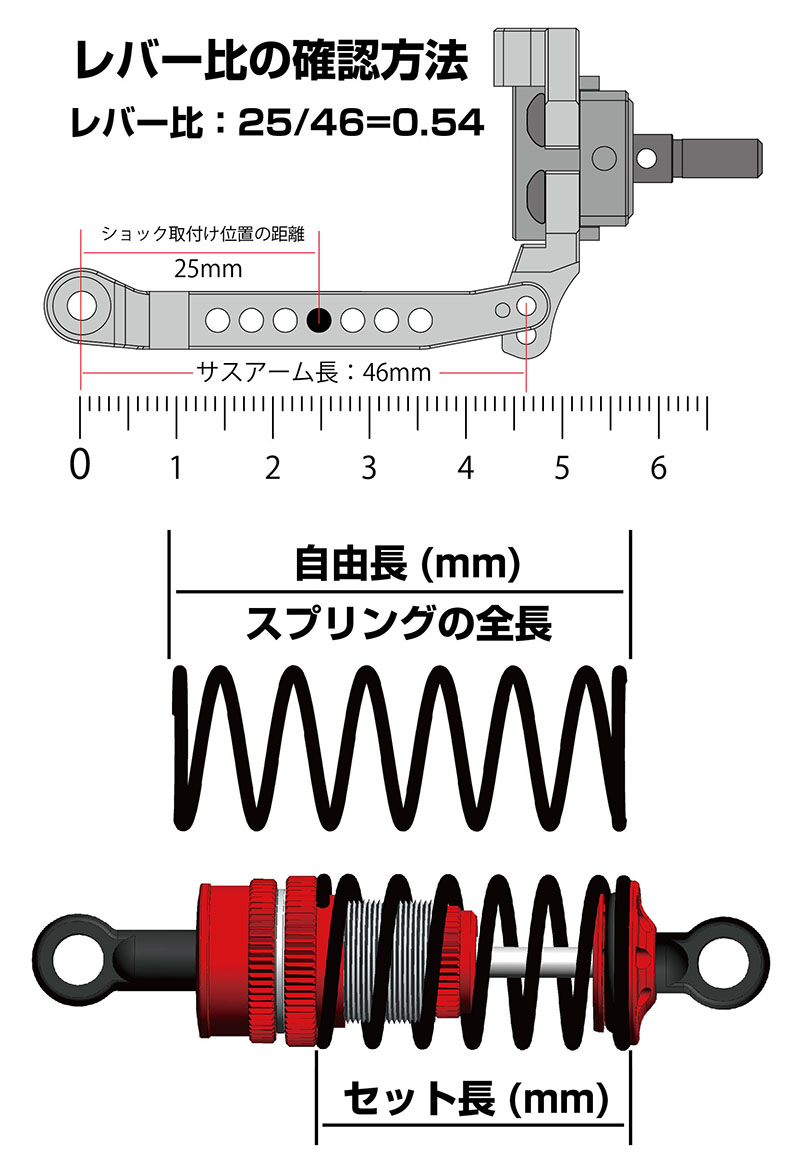
*To make the lever ratio easier to understand intuitively, it is calculated based on what percentage of the suspension arm length the damper is mounted at
(Illustration) 25 ÷ 46 = 0.54 (54%). Although the calculation method differs from that used on the actual vehicle, the meaning is the same.
“1G stroke” refers to the amount of travel from the state where the chassis is lifted (0G) to the state where the chassis is on the ground (1G).
(Illustration) 25 ÷ 46 = 0.54 (54%). Although the calculation method differs from that used on the actual vehicle, the meaning is the same.
“1G stroke” refers to the amount of travel from the state where the chassis is lifted (0G) to the state where the chassis is on the ground (1G).
| Sas-Armstrong Stroke Volume | mm [0G→1G] |
| Damper Stroke Length | mm [0G→1G] |
| Preload | mm |
● This assumes that the weights on the left and right sides are evenly balanced.
● The calculated values assume that the damper is installed vertically. While there will be only a very slight difference in the calculated values if the damper is tilted slightly, dampers that are significantly laid down cannot be calculated correctly.
● If there is slack in the spring when the chassis is raised to 0G, accurate values will not be obtained.
*Please note that the calculation results are simulation values only. Use them for reference purposes only.
No customer feedback for this calculation yet.
You will need data on front/rear weight distribution, spring rates, lever ratios, free spring length, and set spring length.
By default, reference data for rear measurements when using a compression spring with 9.25 coils on the test vehicle (FR-D)
has been entered. Please overwrite this data and recalculate.
Compression Spring Specifications: Free Length: 45 mm 7.25 (52 g/mm) 9.25 (39 g/mm) 11.25 (31 g/mm)