You are using the new UI (Beta).Return to the original UI

This page has been automatically translated by machine translation. Please note that translations may not be entirely accurate.

keisanHigh-precision calculations for everyday life and work

Catenary Curve (Graph and Function When the Heights at Both Ends Are Different)

Author: tsutsutsuExecutions: 2817

※ This library was created by a member. This site is not responsible for its content.

Manage Bookmarks
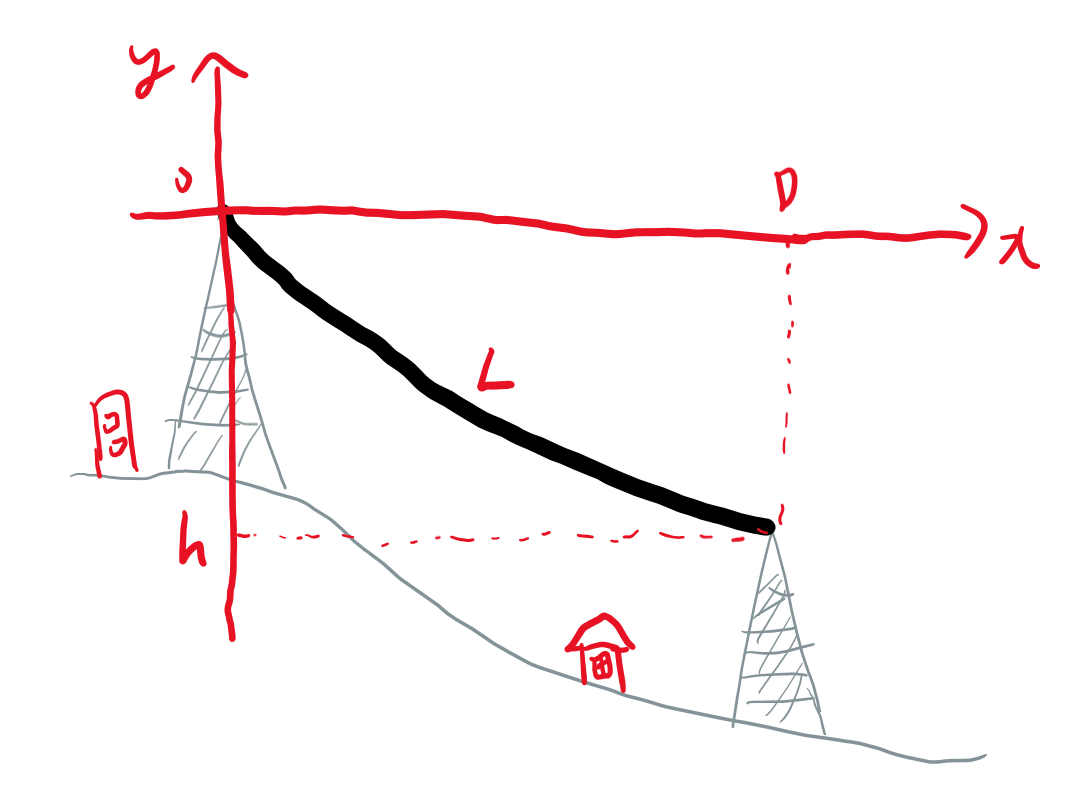
I would like to examine the function of a string suspended between two endpoints at different heights. Now, if we consider a function with one endpoint (which we’ll call the starting endpoint, and the other the ending endpoint) as the origin, it is determined by the horizontal distance D between the endpoints, the height h of the ending endpoint, and the length L of the string, and is expressed as follows.Please note that in the following, cosh refers to the hyperbolic cosine function, not cos(h*...).

*Since the aspect ratio of the generated graph is generally not 1:1, if you wish to obtain a graph that closely resembles reality, please use the values of a and x1 displayed in the first row of the table, along with the following equation, to plot the graph using graphing software or similar tools.
Horizontal distance D between the two ends
Please enter a positive value.
Terminal height h
If the end point is higher than the start point, enter a positive value; if it is lower, enter a negative value.
Thread length L
Please make it greater than the straight-line distance between the two ends.

No customer feedback for this calculation yet.